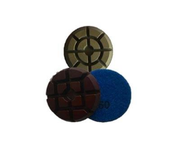
Composition Structure Of Polishing Wheel
Jul 07, 2021
The polishing wheel is generally made of multiple layers of canvas, felt or leather. The two sides are clamped by metal circular plates, and the rim is coated with a polishing agent that is uniformly mixed with micronized abrasives and grease.
During polishing, the high-speed rotating polishing wheel (circumferential speed above 20 m/s) presses against the workpiece, so that the abrasive can roll and micro-cut the surface of the workpiece, thereby obtaining a bright machined surface. The surface roughness can generally reach Ra0.63 ~0.01 micron; when non-greasy matting polishing agent is used, the bright surface can be matted to improve the appearance.
The polishing wheels of various structures made of cotton, linen, woolen or synthetic materials have their unique advantages in terms of flexibility, wear resistance, economy, and polishing effect, and they play an important role in the polishing industry. The flexibility of these polishing wheels depends on many factors such as the material of the substrate, the assembly structure, the number of layers, the size of the pleats, the impregnating agent and the dipping method, the ratio of the inner hole and the outer diameter, and the stitching density.
In order to improve the abrasion resistance of cotton and linen polishing wheels, 45 are mostly used as the base material. Weaving methods, which do not contain abrasives, are used to grind the workpiece with abrasives: at the same time, the substrate generally needs to be immersed, and the impregnated polishing wheel can improve the adhesion of the abrasive, thereby Improve the grinding effect and extend the life of the polishing wheel; using different impregnating agents and impregnation methods, different flexibility and adhesion can be obtained to meet different processing requirements. The polishing wheel generally uses the different colors of the substrate to distinguish its flexibility and adhesion.